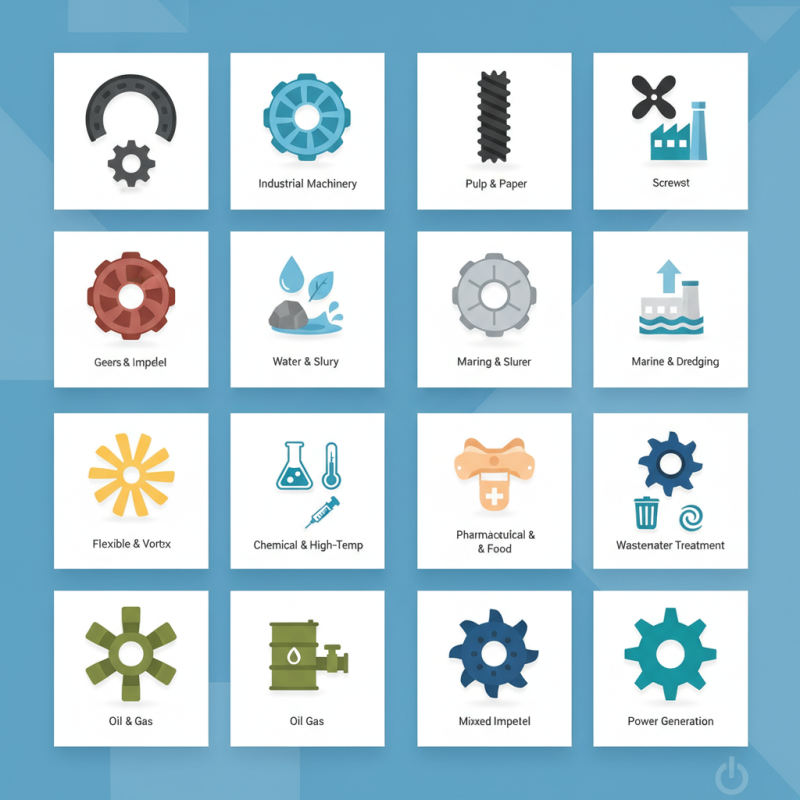
Top 10 Rubber Pump Impeller Types and Their Applications?
Rubber Pump Impellers play a crucial role in various industries. They are designed for efficiency and durability. Understanding their types and applications is essential.
Different designs serve unique purposes. Some impellers handle abrasive fluids, while others manage temperatures well. This versatility highlights their importance in pumping systems.
However, not every impeller suits every application. Choosing the wrong type can lead to inefficiency. It's vital to assess the specific needs of your project. Reflecting on these details ensures optimal performance and resource use.
Overview of Rubber Pump Impellers and Their Characteristics
Rubber pump impellers are essential components in various pumping applications. They are made from materials that offer flexibility and resilience. This design helps them withstand wear and tear. Their soft nature makes them suitable for handling delicate fluids. This can include slurries, chemicals, and even certain food products. The versatility of rubber impellers allows for diverse industrial uses.
One notable feature of rubber impellers is their efficiency in creating suction. They can maintain performance even in challenging environments. However, users often overlook the importance of maintenance. Over time, rubber can degrade, leading to reduced efficiency. Regular checks can prevent potential failures. Some applications push rubber impellers to their limits. In these cases, users may need to reconsider their material choices.
Additionally, understanding the characteristics of different rubber types is crucial. Each type has its own strengths and weaknesses. Some might offer greater resistance to heat, while others can endure harsh chemicals. It's important to match the impeller material to the specific application. This may require some trial and error. Knowing when to adjust is key to optimizing performance.
Common Types of Rubber Pump Impellers and Their Uses
Rubber pump impellers are widely used in many industries due to their versatility. These impellers can handle various fluids, making them popular in applications ranging from agriculture to wastewater management. They are designed to withstand the wear and tear of corrosive materials, offering durability and reliability. When selecting an impeller, it’s vital to consider the fluid characteristics.
One common type is the open impeller. This design allows easy passage of solids and is efficient for sludge pumping. Another type is the closed impeller. It features a shroud and provides higher efficiency. This design is ideal when working with clean fluids. However, it can struggle with solid particles.
Some impellers are reinforced with materials to enhance strength. This feature is crucial for abrasive applications. Yet, these combinations can lead to increased costs. Balancing durability and budget requires careful consideration. Lastly, the semi-open impeller offers a middle ground, performing well in various scenarios. Choosing the right type requires understanding the specific needs of your operation.
Top 10 Rubber Pump Impeller Types and Their Applications
| Impeller Type | Material | Application | Advantages |
| Closed Impeller | Natural Rubber | Water and Wastewater | High efficiency, low axial thrust |
| Open Impeller | Neoprene | Slurry and Viscous Fluids | Handles solids well, easy to clean |
| Semi-Open Impeller | EPDM | Food and Beverage | Versatile, good for sanitary applications |
| Vortex Impeller | SBR | Chemical Processing | Non-clogging, suitable for dirty fluids |
| Mag drive Impeller | FPM | Highly Corrosive Chemicals | No shaft seals, reduced leakage risk |
| Trash Impeller | Natural Rubber | municipal sewage | Robust, handles large debris |
| Propeller Impeller | Polyurethane | Marine Applications | Good flow rate, efficient for water movement |
| Multi-Vane Impeller | Hytrel | HVAC Systems | Stable performance, low vibrations |
| Diaphragm Impeller | Silicone | Medical Applications | Contamination-free, precise flow |
| Centrifugal Impeller | Nitrile | General Industrial Use | High efficiency, easy installation |
Factors to Consider When Choosing a Rubber Pump Impeller
Choosing the right rubber pump impeller is crucial for efficiency. Several factors affect this decision. First, consider the material composition. The hardness and elasticity of rubber can impact its performance under different conditions. Optimal hardness typically ranges from 50 to 80 Shore A for various applications.
Next, assess the operational environment. Impellers encounter abrasive materials frequently. For such scenarios, a more durable rubber blend is essential. For example, using a rubber with enhanced abrasion resistance can significantly prolong the impeller's lifespan. An industry report noted that using the right material can improve pump efficiency by 20%.
Tip: Always review manufacturer specifications. They provide vital insights into the rubber's resistance to temperature and chemicals.
Pump speed and flow requirements are other important factors. High-speed applications may require impellers with specific designs to maintain fluid dynamics. A poor choice could lead to cavitation, causing further damage. Remember that efficiency losses from improper selection can exceed 30% in extreme cases.
Tip: Regularly inspect the impeller for wear. Early detection can prevent costly downtimes and repairs. The right choice today leads to better performance tomorrow.
Applications of Rubber Pump Impellers in Various Industries
Rubber pump impellers play a critical role across various industries. In water treatment, for instance, they ensure efficient fluid movement. According to industry data, approximately 30% of operational issues arise from pump component failures. Rubber impellers offer improved durability and corrosion resistance, which reduces downtime.
In the agricultural sector, rubber impellers help in irrigation systems. They are designed to handle abrasive fluids. A report from the Agricultural Engineering Society indicates that these impellers can increase efficiency by 20%. This results in better water conservation and higher crop yields. Additionally, rubber impellers are also used in food processing. They support hygiene while maintaining performance under demanding conditions.
While rubber pump impellers are effective, they have challenges. Their performance can degrade under extreme temperatures. Regular maintenance is essential but often overlooked. In many cases, companies fail to replace worn-out impellers timely. This can cause significant inefficiencies and costly repairs. Identifying and addressing these issues is vital for long-term effectiveness.
Maintenance and Care Tips for Rubber Pump Impellers
Rubber pump impellers are essential for various applications, such as wastewater management and irrigation. They play a critical role in fluid dynamics. However, maintaining these components is vital for ensuring optimal performance. Regular inspection is necessary to catch wear and tear early. Check for cracks, signs of fatigue, or any abnormal wear patterns. These small details can lead to bigger issues if overlooked.
Proper lubrication is essential too. Ensure you use suitable lubricants to keep the impeller functioning smoothly. Dirty or depleted lubricants may cause friction, reducing efficiency. It's not just about replacing worn parts; cleaning is equally important. Remove any debris or buildup that could obstruct flow. Remember, an impeller underperforming is often a result of neglect.
Operators sometimes miss the schedule for regular maintenance checks. Setting reminders can help. Even a simple oversight can lead to significant failures. Evaluate your practices and adjust as needed. When rubber pump impellers receive attentive care, they extend their lifespan and improve productivity. Regular attention may seem tedious, but it pays off in the long run.