
China’s resistor industry serves a wide range of electronics markets, from industrial controls to test equipment. For buyers comparing China Top Metal Film Resistor Manufacturers, a polished catalog is only a starting point. The important questions are practical: Can the supplier maintain resistance tolerance across batches? Are temperature coefficient, noise, power rating, and operating limits clearly documented? Small details matter. A resistor that looks identical in a product photo may perform differently under heat or repeated load.
This guide introduces manufacturers and explains how to assess them using verifiable signals, rather than promotional claims alone. It considers product range, production capability, quality systems, customization, export experience, and the clarity of technical documents. Datasheets, sample testing, audit records, and direct engineering discussions can help confirm whether a company fits a specific design. No single supplier is best for every application. That is worth remembering. A low quoted price may not include stable lot control, responsive technical support, or packaging suited to storage and assembly. Supplier information can also change, so buyers should confirm current certifications and specifications before making a decision. The aim is not to declare a universal winner, but to make comparison more disciplined. A careful shortlist can reduce surprises later, though it cannot replace testing in the buyer’s own circuit. That step is easy to postpone—and easy to regret.
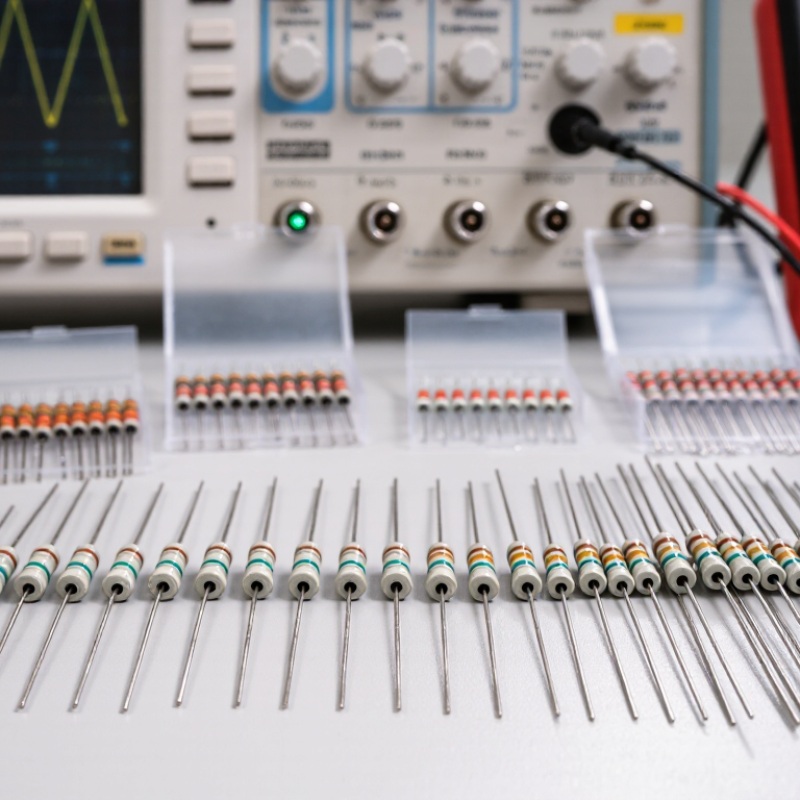
A metal film resistor limits current by turning electrical energy into heat. Its resistive element is a very thin metal alloy layer deposited on a ceramic core. The layer may be only micrometers thick. Small details matter. During production, a precise spiral is often cut into the film with a laser. This lengthens the current path and sets the resistance. Metal end caps and lead wires provide electrical connections, while an outer coating protects the element from moisture and handling.
When voltage is applied, electrons meet resistance as they pass through the film, producing heat. Ohm’s law links voltage, current, and resistance: for a fixed voltage, higher resistance means lower current. A 10 kΩ part, for example, allows less current than a 1 kΩ part under the same conditions. Metal film types are commonly chosen for relatively low noise and stable performance, but actual tolerance and temperature behavior depend on the part’s specifications. Heat still matters. A resistor operated near its power limit may drift or fail sooner than expected. I sometimes find the rating easy to overlook; the surrounding airflow and circuit layout count too.
Metal film resistors made in China typically begin with a ceramic core, often alumina, cleaned before a thin resistive alloy layer is deposited. Vacuum deposition helps create a consistent film. Technicians then attach metal end caps and cut a narrow spiral into the coating with a laser. This lengthens the current path and sets resistance. Then comes trimming. The part is measured again, because small changes in film thickness or laser depth can shift its value.
After trimming, manufacturers apply a protective coating, add leads, and mark the component. Automated equipment checks resistance and screens for defects. IEC 60115-1:2020 provides test methods for fixed resistors, including electrical and environmental testing. For value selection, IEC 60063 defines preferred-number series: E24 has 24 values per decade, while E96 has 96. These series help factories align production values with circuit-design needs. Typical precision options include ±1% tolerance and a temperature coefficient around 50 ppm/°C, though specifications vary by product.
Tips: Ask for resistance tolerance, temperature coefficient, rated power, and test conditions—not just the nominal value. A sample batch can reveal coating or lead issues early. Quality checks are useful, but no production line is perfectly uniform; request recent inspection data before placing a large order.
Among China’s leading metal film resistor manufacturers, the strongest candidates are usually established component producers with dedicated thin-film lines, rather than general traders. Look for factories that can document resistance tolerance, temperature coefficient, rated power, and inspection methods for each product family. A practical comparison might include 0.25-watt, 1% parts on tape and reel, with clear batch identification and test records. Small details matter.
A reliable manufacturer should explain how it controls film deposition, trimming, coating, and final electrical testing. Ask for recent sample results and production-lot traceability, not just a polished catalog. Some suppliers offer custom values or packaging, but capability claims need verification against actual samples. A certificate alone is not proof of consistent output. Production capacity, lead times, and communication also help distinguish a capable factory from a reseller. No shortlist is perfect; published specifications can leave out real-world variation. For a fair assessment, compare samples under the same test conditions and confirm that quoted specifications match the parts delivered.
| Evaluation Dimension | Common Industry Reference | What Buyers Should Verify |
|---|---|---|
| Resistance tolerance | Metal film resistor product lines commonly include tolerances such as ±1%; precision series may offer tighter tolerances, depending on the part. | Check the tolerance for the exact resistance value and part number, rather than relying on a general product-family description. |
| Temperature coefficient (TCR) | Published metal film resistor options can include TCR ratings in the range of tens to hundreds of ppm/°C; the available rating varies by series. | Confirm the specified TCR, its test conditions, and the operating temperature range in the product datasheet. |
| Rated power | Through-hole metal film resistors are offered in multiple body sizes and power ratings. The rating depends on construction, ambient temperature, and mounting conditions. | Compare the rated power and derating curve for the intended operating temperature and circuit layout. |
| Resistance range | Available resistance values vary by series. Standard preferred-value sequences, including E24 and E96, are commonly used in resistor selection. | Request the series-specific resistance range and confirm whether the required value is a standard offering or a special order. |
| Operating temperature | Many general-purpose resistor datasheets specify operation across a temperature range; limits differ among products and construction types. | Check the minimum and maximum operating temperatures and any power derating requirements in the datasheet. |
| Reliability and qualification | IEC 60115-1 is a general specification for fixed resistors. AEC-Q200 is a passive-component stress-test qualification used for automotive applications. | Verify the applicable standard, qualification status, test report, and whether they apply to the specific part number being quoted. |
| Quality documentation | Datasheets, inspection records, and traceability information are commonly requested during component sourcing and qualification. | Ask for current revision-controlled datasheets, lot traceability details, and the quality documents relevant to the purchase. |
| Supply and customization | Lead time, packaging, minimum order quantity, and customization availability are order- and product-specific rather than universal specifications. | Confirm current stock, production lead time, packaging format, minimum order quantity, and sample availability in writing. |
Note: This table summarizes general product-selection criteria and industry references. Specifications and qualifications vary by series and part number; verify all values against the manufacturer’s current datasheet.
China’s metal film resistor suppliers differ less by catalog size than by process control. Some focus on standard axial parts, while others offer tight tolerance, low temperature coefficient, flame-retardant coatings, or custom resistance values. Ask how resistance drift is measured, not only what the datasheet promises. A stable batch matters. So does a clear test record.
The Automotive Electronics Council’s AEC-Q200 Rev E qualification framework includes a 1,000-hour operational-life test for passive components. This is a useful benchmark for buyers comparing suppliers serving automotive applications, though qualification alone does not prove every production lot performs identically. Check sample reports for resistance change, temperature coefficient, rated power, and pulse handling. A 0.25-watt part on paper may behave differently when packed tightly on a warm board.
Manufacturing capability also shows in traceability and response time. Can the factory link a reel to its material and test records? Can engineers adjust film trimming or coating after a design review? These details separate a low-cost quote from a dependable supply program. Catalog claims can look cleaner than batch records. That gap deserves scrutiny. Ask for recent lot data and independent test results before approving a source.
When evaluating Chinese metal film resistor suppliers, ask for lot-specific test records, not only a polished catalogue. Check resistance tolerance, temperature coefficient, rated power, and operating-temperature limits against your design. IEC 60115-1 provides test methods for fixed resistors; request results that identify the test conditions and sample size. A certificate without traceable batch numbers is weak evidence. Small detail, big difference.
Also inspect the production process. Ask how incoming film, trimming, coating, and solderability are controlled, then compare the answers with an independent factory audit. The WSTS May 2025 industry report recorded worldwide semiconductor sales of US$627.6 billion in 2024. That figure is not a resistor-market measure, but it reflects the scale of electronics supply chains—and why component traceability matters. Request samples from more than one lot, then measure resistance before and after soldering and temperature exposure. A sample can look perfect and still drift. I would also verify lead times, minimum order quantities, and change-notification practices in writing. One weakness in many buyer checklists: they overvalue a low unit price and undercheck process changes. That is easy to miss.